
Watlow F4 Controller Manual: A Comprehensive Guide
The Watlow F4 series offers versatile temperature control‚ boasting a 4.3-inch touch panel and advanced features like cascade‚ ratio‚ and differential control options.
The Watlow F4 controller represents a significant advancement in industrial temperature and process control technology. Designed for a broad spectrum of applications – including semiconductor manufacturing‚ plastic processing‚ packaging‚ and general industrial processes – the F4 delivers both precision and flexibility. This 1/4 DIN controller is built around a powerful 16-bit microprocessor‚ ensuring high accuracy and reliable performance.
Its intuitive 4.3-inch color graphical touch panel dramatically simplifies operation‚ potentially reducing the need for extensive user manuals. The F4 isn’t just a controller; it’s a complete solution‚ integrating essential features like serial communication and dual alarm relays directly into the base unit. With options for advanced control strategies‚ the F4 adapts to complex process requirements‚ offering capabilities like cascade‚ ratio‚ and differential control.
Understanding the F4 Controller Series
The Watlow F4 controller series is characterized by its adaptability and comprehensive feature set‚ designed to address diverse industrial process control needs. The SERIES F4 is packaged with a Watlow controller‚ offering a robust and reliable solution. It distinguishes itself through advanced control options‚ including cascade‚ ratio‚ differential‚ duplex slide wire‚ and retransmit functionalities.

A key element of the F4 series is its user-centric design‚ highlighted by the 4.3-inch color graphical touch panel‚ promoting ease of use. Furthermore‚ the inclusion of serial communication capabilities and dual alarm relays as standard features enhances its versatility. Four digital inputs allow for remote modification of controller operation or the display of pre-defined operator messages‚ increasing operational flexibility and control.
Key Features and Benefits
The Watlow F4 controller delivers exceptional performance and usability‚ making it a standout choice for industrial temperature control. Its core benefits stem from its advanced features‚ including cascade‚ ratio‚ and differential control capabilities‚ optimizing process efficiency. The intuitive 4.3-inch color graphical touch panel significantly simplifies operation‚ potentially reducing the need for extensive user manuals.
Furthermore‚ the F4 boasts integrated serial communication and dual alarm relays‚ enhancing connectivity and safety. Four digital inputs provide remote control options and customizable operator messages‚ increasing flexibility. Built with a 16-bit microprocessor‚ the F4 ensures accuracy and reliability‚ offering performance advantages you can consistently
Display and User Interface
The Watlow F4 controller features a vibrant 4.3-inch color graphical touch panel‚ designed for intuitive operation and clear visualization of process data. This user-friendly interface minimizes complexity‚ potentially eliminating the need for cumbersome manuals. The touch screen allows for easy navigation through menus‚ setpoint adjustments‚ and alarm configurations.
Operators can quickly monitor critical parameters and respond to process changes with ease. The display provides a comprehensive overview of the controlled variable‚ setpoint‚ and output status. Furthermore‚ the F4 supports customizable operator messages‚ displayed via the digital inputs‚ offering targeted guidance and information directly on the screen‚ enhancing overall usability and control.

4.3-inch Color Graphical Touch Panel
The centerpiece of the Watlow F4 controller’s user experience is its bright‚ 4.3-inch color graphical touch panel. This display delivers exceptional clarity and allows for intuitive interaction with the controller’s functions. The graphical interface presents process information in an easily understandable format‚ reducing training time and minimizing errors.

Its responsive touch capability enables quick and precise adjustments to setpoints‚ alarm limits‚ and other critical parameters. The color display enhances visibility‚ highlighting important data and alerts. This best-in-class ease of use significantly simplifies operation‚ potentially rendering complex user manuals less necessary for routine tasks and improving overall process control efficiency.

Controller Dimensions and Mounting
The Watlow SERIES F4 is a 1/4 DIN temperature process controller‚ designed for seamless integration into a variety of industrial control panels. Its compact dimensions ensure it fits comfortably within space-constrained environments‚ common in semiconductor manufacturing‚ plastic processing‚ and packaging equipment.
The controller is packaged with a NEMA enclosure‚ providing robust protection against dust‚ debris‚ and other environmental factors. Mounting is straightforward‚ utilizing a standard panel cutout‚ simplifying installation and maintenance. This design prioritizes both functionality and ease of integration‚ allowing for quick deployment in diverse industrial applications. The robust construction and secure mounting contribute to long-term reliability and stable performance.
Input Specifications
The Watlow F4 controller demonstrates exceptional versatility through its broad range of input capabilities‚ catering to diverse industrial sensing needs. It readily accepts thermocouple inputs‚ accommodating various types for temperature measurement across different ranges and applications. Furthermore‚ the controller supports RTD (Resistance Temperature Detector) inputs‚ providing high accuracy and stability for critical processes.

Beyond these standard options‚ the F4 also offers analog input options‚ enabling integration with external sensors and signals. This flexibility allows for monitoring of parameters beyond temperature‚ expanding the controller’s functionality. A 16-bit microprocessor ensures accurate signal processing‚ delivering reliable and consistent performance you can consistently
Thermocouple Input Types
The Watlow F4 controller supports a comprehensive array of thermocouple types‚ ensuring compatibility with a wide spectrum of temperature sensing applications. These include Type J‚ known for its broad range and relatively low cost‚ and Type K‚ the most common type due to its versatility and wide temperature range. Type T thermocouples are also supported‚ offering excellent stability at lower temperatures.
Additionally‚ the F4 accommodates Type E‚ Type N‚ Type R‚ Type S‚ and Type B thermocouples‚ extending its capabilities to high-temperature measurements and specialized environments. The controller’s 16-bit microprocessor ensures accurate cold junction compensation‚ vital for precise temperature readings. Proper thermocouple selection is crucial for optimal performance‚ considering factors like temperature range‚ environment‚ and required accuracy.

RTD Input Types
The Watlow F4 controller provides robust support for Resistance Temperature Detectors (RTDs)‚ offering high accuracy and stability in temperature measurement. It readily accepts Pt100 RTD inputs‚ the industry standard‚ known for their precision and reliability across a broad temperature spectrum. The controller also accommodates Pt1000 RTDs‚ providing increased sensitivity for applications requiring finer temperature resolution.
Furthermore‚ the F4 supports Ni100 and Cu100 RTD types‚ expanding its versatility to suit diverse industrial needs. Accurate RTD measurements depend on proper wiring configurations – two‚ three‚ and four-wire options are supported‚ with four-wire providing the highest accuracy by compensating for lead wire resistance. The controller’s internal circuitry ensures precise resistance measurement and conversion to temperature‚ delivering dependable performance.
Analog Input Options
The Watlow F4 controller expands its functionality beyond traditional temperature sensors with versatile analog input capabilities. It accepts 4-20mA current loop inputs‚ a common industrial standard for transmitting process variables‚ offering excellent noise immunity and long-distance signal transmission. Voltage inputs‚ ranging from 0-5VDC and 0-10VDC‚ are also supported‚ providing flexibility for interfacing with a wider range of sensors and instrumentation.
These analog inputs can be configured to represent various process parameters beyond temperature‚ such as pressure‚ flow rate‚ or level. The F4’s scalable input allows for precise calibration to match the sensor’s output range. This adaptability makes the controller suitable for diverse applications requiring multi-variable control or monitoring. Proper wiring and signal conditioning are crucial for accurate analog input readings‚ ensuring reliable process control.
Output Control Options
The Watlow F4 controller provides a comprehensive suite of output control options to manage heating or cooling processes effectively. These options include relay outputs‚ ideal for simple on/off control of devices like heaters or valves‚ offering a cost-effective solution for basic applications. Furthermore‚ the F4 supports analog outputs‚ typically 4-20mA or 0-10VDC‚ enabling proportional control for precise temperature regulation and compatibility with external control systems.
The analog outputs can be configured to represent the control signal or a process variable‚ allowing for closed-loop control and data logging. Users can select the output type and range to match the requirements of their specific application. Proper configuration and calibration of the output signals are essential for optimal performance and accurate process control‚ ensuring the desired heating or cooling profile is achieved.
Relay Output Configuration
The Watlow F4 controller’s relay outputs offer a straightforward method for controlling devices requiring on/off switching. These outputs are particularly useful for applications like heater activation‚ valve control‚ or alarm signaling. Configuration involves defining the relay’s function – typically heat‚ cool‚ or alarm – and setting appropriate high and low setpoints to trigger the relay’s activation.
Users must carefully consider the relay’s contact rating to ensure it’s compatible with the load being controlled‚ preventing damage to both the controller and the connected device. Hysteresis settings can be adjusted to prevent rapid cycling of the relay around the setpoint. Proper wiring and adherence to safety guidelines are crucial when implementing relay output configurations‚ guaranteeing reliable and safe operation of the controlled process.
Analog Output Configuration
The Watlow F4 controller provides flexible analog output options for transmitting process variables or control signals. These outputs‚ typically 4-20mA or 0-10V‚ enable integration with external devices like recorders‚ PLCs‚ or variable frequency drives. Configuration involves selecting the desired output type and assigning it to a specific process variable‚ such as temperature or setpoint.
Scaling parameters are crucial for mapping the process variable’s range to the analog output’s range‚ ensuring accurate representation. Users can also configure zero and span adjustments for calibration. Proper wiring and grounding are essential for minimizing noise and ensuring signal integrity. Utilizing analog outputs allows for seamless communication and control within a broader automation system‚ enhancing process monitoring and optimization capabilities.
Advanced Control Features
The Watlow F4 controller extends beyond standard PID control‚ offering a suite of advanced features for complex process management. Cascade control utilizes a secondary loop to improve disturbance rejection‚ while ratio control maintains a consistent relationship between two variables. Differential control allows for setpoint adjustments based on the difference between two measured values.
Furthermore‚ duplex slide wire control enables precise multi-zone temperature regulation. Retransmit options provide a scaled output representing any process variable. These features‚ coupled with a powerful 16-bit microprocessor‚ deliver exceptional performance and adaptability. Implementing these advanced strategies optimizes process stability‚ efficiency‚ and product quality‚ making the F4 ideal for demanding industrial applications.
Cascade Control Implementation
Cascade control‚ a powerful feature of the Watlow F4‚ enhances process regulation by nesting two control loops. The primary loop responds to the main process variable‚ while a secondary‚ faster loop adjusts the primary loop’s setpoint. This inner loop typically controls a rapidly responding element‚ like a valve position‚ minimizing the impact of disturbances before they affect the primary process.
Implementing cascade control requires careful tuning of both loops. The inner loop should be significantly faster than the outer loop. This configuration improves stability‚ reduces overshoot‚ and provides tighter control‚ particularly in processes with significant lag or disturbances. The F4’s advanced capabilities simplify setup and optimization of this sophisticated control strategy.
Ratio Control Explained
Ratio control‚ available within the Watlow F4 controller‚ maintains a consistent proportional relationship between two process variables. Unlike cascade control focusing on nested loops‚ ratio control directly links the flow rates of multiple components. This is crucial in applications like blending‚ mixing‚ or chemical reactions where maintaining a precise ratio is paramount for product quality and process efficiency.
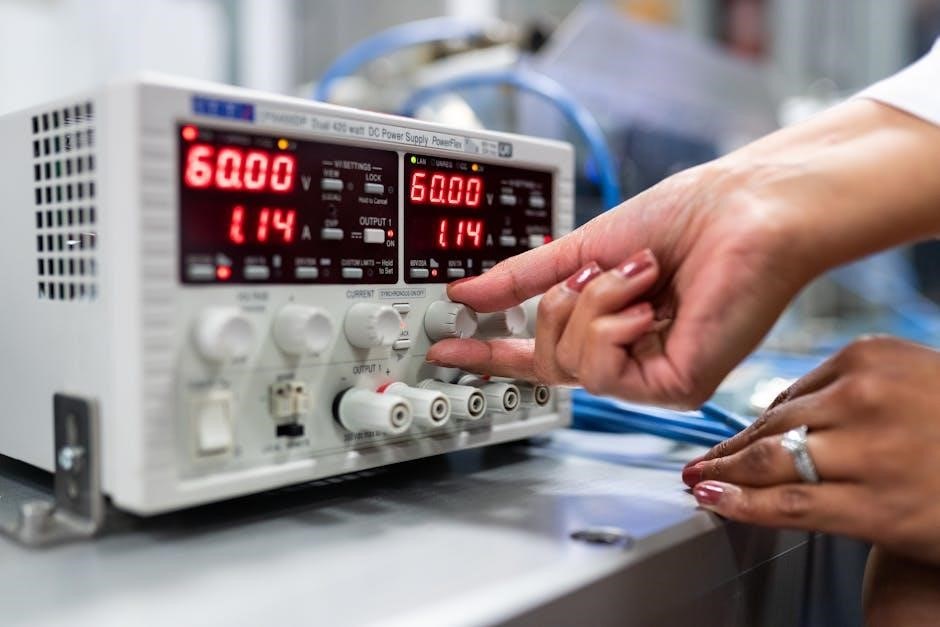
The F4’s ratio control function continuously adjusts one variable based on changes in the other‚ ensuring the desired ratio is upheld despite fluctuations. Setup involves defining the target ratio and identifying the master and slave variables. This feature minimizes waste‚ optimizes resource utilization‚ and delivers consistent output‚ making it ideal for demanding industrial processes.
Differential Control Settings
Watlow F4 controllers offer differential control‚ a sophisticated method for maintaining a specific temperature difference between two points in a process. This is particularly useful in applications like film extrusion‚ mold temperature control‚ or heat exchanger regulation‚ where the temperature gradient is as important as absolute temperatures.

The F4’s differential control function monitors two separate temperature inputs and adjusts the output to maintain a user-defined difference. This eliminates the need for complex calculations or external control loops. Setup involves designating the ‘high’ and ‘low’ temperature inputs and setting the desired differential value. Utilizing this feature enhances process stability‚ improves product consistency‚ and optimizes energy efficiency by focusing on the temperature relationship rather than individual values.
Communication Protocols
The Watlow F4 controller supports serial communication‚ enabling integration with various industrial systems for data logging‚ remote monitoring‚ and supervisory control. This connectivity allows for streamlined process management and enhanced data analysis capabilities.
Specifically‚ the F4 utilizes serial communication for transmitting process variables‚ setpoints‚ and alarm status to external devices like PLCs‚ computers‚ or HMIs. Configuration of the serial port involves setting parameters such as baud rate‚ parity‚ and data bits. This facilitates seamless communication and data exchange. Furthermore‚ the inclusion of serial communication in the base unit expands the controller’s functionality‚ allowing for comprehensive process oversight and control beyond the local operator interface.
Serial Communication Setup
Establishing serial communication with the Watlow F4 controller requires careful configuration of several key parameters to ensure reliable data transfer. These settings include selecting the appropriate baud rate – the speed at which data is transmitted – and configuring parity‚ which checks for transmission errors.
Data bits and stop bits must also be correctly defined to frame the data properly. Accessing these settings is typically done through the controller’s user interface‚ navigating to the communication menu. Proper setup is crucial for successful integration with PLCs‚ computers‚ or HMIs. Incorrect settings will result in communication failures. Verify compatibility with the receiving device before finalizing the configuration‚ ensuring seamless data exchange for effective process monitoring and control.
Alarm Relay Configuration
The Watlow F4 controller incorporates dual alarm relays‚ providing flexible options for signaling process deviations. Configuration involves defining alarm types – high‚ low‚ or deviation from setpoint – and setting corresponding trigger points. Hysteresis‚ a deadband around the trigger point‚ prevents rapid relay cycling.
Relay outputs can be configured as normally open (NO) or normally closed (NC) to suit various application requirements. Users can also assign specific operator messages to each alarm‚ providing clear indication of the alarm condition on the controller’s display. Proper alarm configuration is vital for ensuring timely response to process upsets and maintaining safe operation. Thorough testing after setup is recommended to verify correct functionality.
Digital Input Functionality
The Watlow F4 controller features four digital inputs‚ enhancing its operational flexibility and remote control capabilities. These inputs allow for external modification of controller operation or triggering of pre-defined operator messages displayed on the unit. Functions assigned to digital inputs can include setpoint changes‚ enabling/disabling outputs‚ or initiating specific control modes.
Digital inputs can be configured for various trigger types – sinking or sourcing – to accommodate different wiring configurations. Utilizing digital inputs streamlines process adjustments and provides a convenient method for remote monitoring and intervention. Careful consideration of input assignments is crucial for ensuring seamless integration with external systems and achieving desired control outcomes.
Remote Operation via Digital Inputs
The Watlow F4 controller’s four digital inputs facilitate comprehensive remote operation‚ extending control beyond the operator interface. These inputs enable external devices to modify setpoints‚ adjust control parameters‚ or initiate specific actions within the control loop. This capability is invaluable for automated systems and applications requiring remote monitoring and intervention.
Remote operation via digital inputs allows for integration with PLCs‚ switches‚ or other control systems‚ enhancing process automation. Configuration options include assigning inputs to trigger alarms‚ switch between control modes‚ or enable/disable outputs. Proper wiring and configuration are essential for reliable remote control‚ ensuring seamless communication between the controller and external devices. This feature significantly expands the F4’s versatility.
Operator Messages and Digital Inputs
The Watlow F4 controller cleverly integrates digital inputs with customizable operator messages‚ providing a powerful communication interface for operators. These inputs can be programmed to display pre-defined messages on the 4.3-inch touch panel‚ alerting personnel to specific process conditions or required actions. This feature enhances situational awareness and streamlines troubleshooting.

By assigning digital inputs to trigger relevant messages – such as “Check Heater” or “Material Low” – operators receive immediate‚ clear guidance. This reduces response time and minimizes potential errors. The flexibility of message customization allows tailoring the system to specific application needs. Utilizing digital inputs for operator messaging improves overall process efficiency and safety‚ offering a user-friendly experience.
Troubleshooting Common Issues
When facing operational challenges with the Watlow F4 controller‚ a systematic approach is crucial. Initial checks should verify power supply integrity and proper wiring connections. If the display is unresponsive‚ examine the backlight settings and touch screen calibration. For control output discrepancies‚ confirm correct parameter configuration and sensor functionality.
Error codes‚ displayed on the 4.3-inch screen‚ provide valuable diagnostic clues; referencing the manual’s error code section is essential. Common issues include sensor failures‚ incorrect setpoint values‚ or communication errors. Regularly inspecting connections and ensuring proper grounding can prevent many problems. If issues persist‚ consult the Watlow documentation or contact technical support for assistance‚ ensuring a swift return to optimal performance.
Error Codes and Their Meanings
The Watlow F4 controller utilizes a comprehensive error code system to pinpoint operational issues. These codes‚ displayed on the 4.3-inch graphical touch panel‚ offer critical diagnostic information. For instance‚ a “Sensor Open” code indicates a disconnected or faulty sensor‚ while “Setpoint Exceeded” signals a temperature beyond the programmed limit.
“Communication Error” suggests a problem with serial communication setup‚ and “Output Failure” points to issues with relay or analog output configuration. The manual provides a detailed table listing each code‚ its description‚ and recommended corrective actions. Understanding these codes is vital for efficient troubleshooting‚ minimizing downtime‚ and ensuring accurate process control. Always consult the official Watlow F4 documentation for the most up-to-date and precise error code definitions.
Basic Troubleshooting Steps
When encountering issues with the Watlow F4 controller‚ begin with fundamental checks. First‚ verify power connections and ensure the unit is receiving adequate voltage. Next‚ inspect sensor wiring for looseness or damage‚ confirming correct thermocouple or RTD input types are selected. Examine output connections – relay or analog – to rule out wiring faults.
Review alarm relay configuration settings and digital input functionality to ensure they aren’t causing unintended behavior. Utilize the controller’s display to check for error codes‚ referencing the manual for their meanings. If communication errors arise‚ double-check the serial communication setup. A systematic approach‚ combined with the F4’s diagnostic features‚ will often resolve common problems efficiently.
Safety Precautions
Prior to installing or servicing the Watlow F4 controller‚ always disconnect power to prevent electrical shock. Qualified personnel should perform all wiring and maintenance‚ adhering to local and national electrical codes. Ensure proper grounding to minimize the risk of hazardous voltage. Avoid operating the controller in environments exceeding its specified temperature or humidity ranges.
Do not attempt to disassemble or modify the controller beyond the procedures outlined in this manual‚ as this could compromise safety features. Regularly inspect wiring for damage and replace worn components promptly. Be cautious when handling hot sensors or process connections. Always wear appropriate personal protective equipment (PPE) during installation and maintenance‚ prioritizing personal safety.